Can AI predict EUR/USD from the news? 120 forecasts later
Short answer: no. For a month, an AI model read the news every weekday morning and called the direction of three currency pairs before the session opened. Out of 120 calls, 60 were right and 60 were wrong. That is a coin flip, and after trading costs, following it would have lost money.
The idea
Language models can now read a whole morning's worth of central-bank comments, data previews and analyst notes in seconds. So the pitch writes itself: let the AI read the news, tell you whether EUR/USD goes up or down today, and trade on it. Plenty of "AI signal" services sell exactly this.
Why it feels like it should work
- News really does move currencies. A surprise in US jobs data or an ECB comment can push EUR/USD 50 pips in minutes.
- AI is very good at explaining a move after it happened. Read any post-session summary and the story sounds obvious.
- A few lucky calls in a row look like skill. With no record kept, nobody counts the misses.
The rules of the game
- What was forecast: EUR/USD, EUR/CHF and USD/CHF, up or down, for a fixed window: the European session (08:00–12:00 UTC) and the US session (12:00–21:00 UTC). The first week used one whole-day window instead.
- Who forecast: an AI model (Anthropic's Claude), running on a schedule before each window opened. It read the current news and got statistical context from 15 years of hourly prices: how each pair usually behaves in that session, on that weekday, after big moves.
- No hindsight: every forecast was written to a version-controlled file before the window started, with a timestamp. Nothing was edited afterwards.
- Scoring: a call is a hit if the pair closed the window on the called side of where it opened. Every call counts, including the boring ones.
- Period: 5 October to 3 November 2026, 22 trading days, 120 forecasts.
What happened
Out of 120 calls, 60 were right. The chart breaks that down by currency pair and by session.
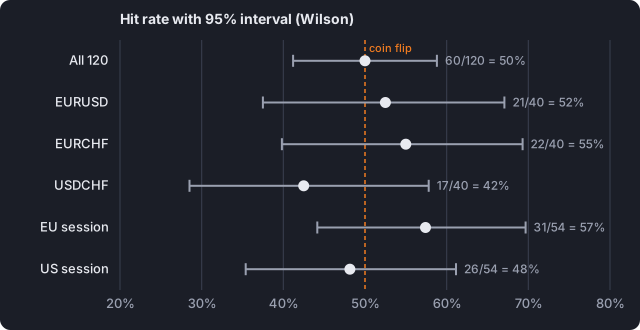
How to read it: each dot is the share of calls that were right, and the line around it is the range where the true hit rate most likely sits, given how few calls there are. The orange dashed line is a coin flip. Every line on the chart crosses it. None of the groups can be told apart from guessing, not even the best-looking one.
The two bottom rows are the most tempting. The European session (57%) looks clearly better than the US one (48%), and it is easy to conclude "just trade the morning calls". But look at how far those two lines overlap. We split the results six ways, and with 54 calls per session a gap this size shows up by chance about one time in three. That is exactly how people fool themselves.
The AI knew it was guessing. Its own confidence on every single call was between 50% and 54%. It never claimed an edge it did not have, which is more than most signal sellers can say.
Live data · updated every evening
See every forecast behind these numbers. What the AI called and why, how the price actually moved, and the news behind each hit and miss, all 120 of them and counting.
What the spread took
Being right half the time is one thing; what matters to a trader is the money. The table shows what you would have made by trading every call and closing at the end of its window, before and after a typical retail spread (about 1 pip on EUR/USD, 1.5 on USD/CHF and 2 on EUR/CHF).
| Group | Calls | Hit rate | Before costs | After costs |
|---|---|---|---|---|
| All | 120 | 50% | −78 pips | −258 pips |
| EUR/USD | 40 | 52% | +27 pips | −13 pips |
| EUR/CHF | 40 | 55% | +22 pips | −58 pips |
| USD/CHF | 40 | 42% | −128 pips | −188 pips |
| EU session | 54 | 57% | +150 pips | +69 pips |
| US session | 54 | 48% | −140 pips | −222 pips |
| Whole-day window (first week) | 12 | 25% | −88 pips | −106 pips |
Two things stand out. First, look at EUR/USD and EUR/CHF: both were right more than half the time and were still in the red once the spread was paid. A small edge in direction is eaten by the cost of taking every trade. Second, the European session is the only line that ended up in profit. That is the same trap as in the chart above: one month, one lucky slice out of six. If it is real, it will still be there in six months, and we will report it either way.
Why the misses happened
After each session, we checked what actually moved the price and tagged each miss:
- 34 of 60 misses had no clear news driver at all. The price just drifted. You cannot forecast noise from headlines.
- 15 were reversals on news that broke during the window, after the forecast was made.
- 6 were cases where the news was already priced in before the window opened.
That is the core problem. By the time news is readable, the market has usually traded on it already, and what happens next depends on news that has not been written yet.
Where this leaves us (for now)
Not there yet. Reading the news, even very quickly and very well, did not predict the next few hours of EUR/USD, EUR/CHF or USD/CHF. 60 hits out of 120 is what a coin would have done, and to be fair to the coin, it works for free.
What it would take to beat the coin
- A real edge, well above 50%. These windows moved about 14 pips on average, so with a 1.5-pip spread a forecast has to be right about 55% of the time just to break even.
- Faster reaction than the market, which a model reading published articles will never have. The firms that profit from news trade it in milliseconds, on the raw data release.
- Many more forecasts. Even a real 55% edge would need several hundred calls to tell apart from luck. We keep running the experiment and will update this article.
This is an ongoing forward test. See every forecast: what was called and why, how the price moved, and the news behind each hit and miss. It updates every evening.